

A Holy Week Pause
Thanks for being gracious.

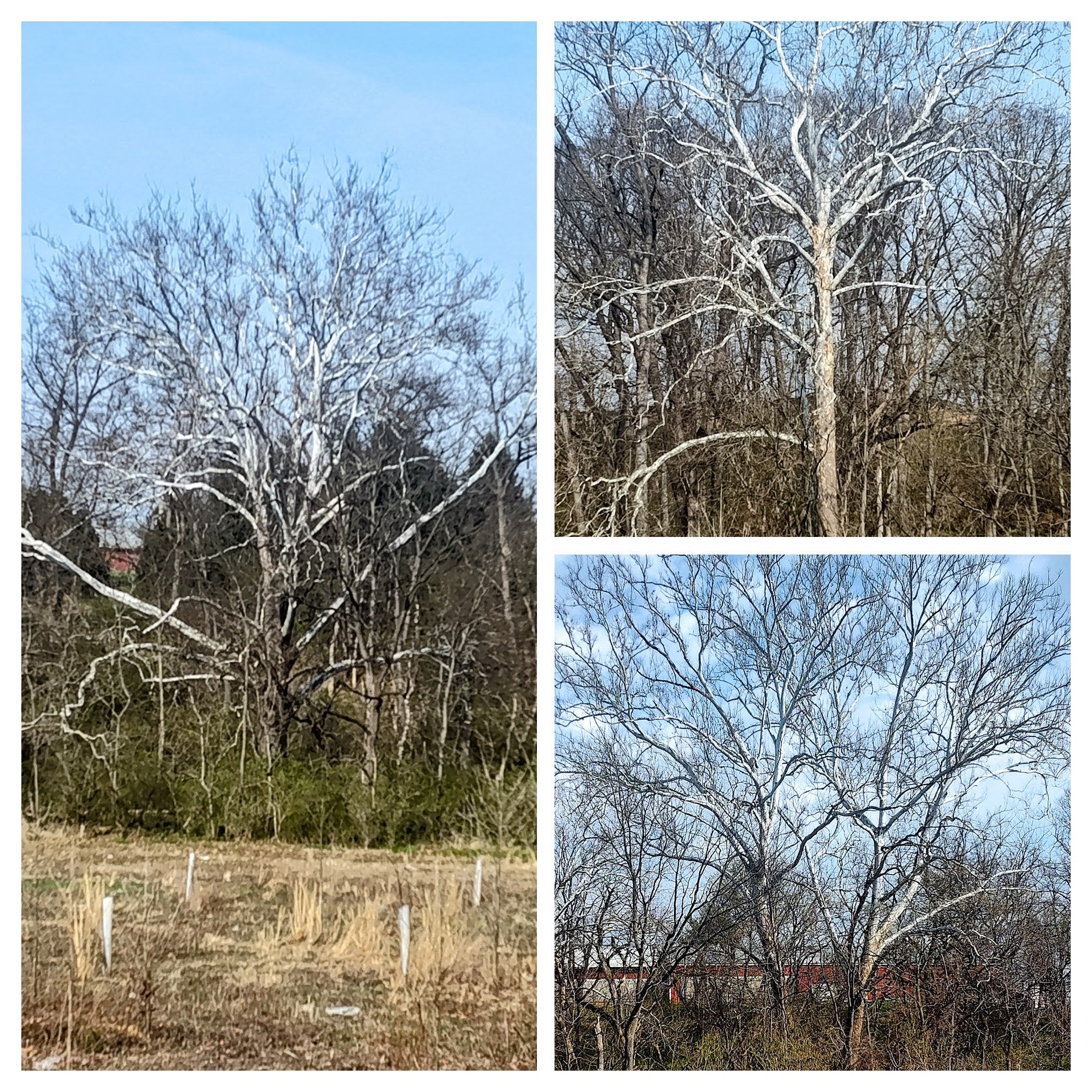
My wife was commenting just the other day on how much she likes the Sycamore trees behind our house. It made me think of an article I wrote about one of these beautiful trees over two years ago. I decided to reprise that article for anyone who may have missed it back then. (It also gives me a little bit more margin during Holy Week.)
So, I hope you enjoy the reflection.
hehe Pun intended.
You’ll have to read on now.
Originally posted February 12, 2024
His life brought light to everyone.
The sycamore reflects—adding nothing to—the sun.
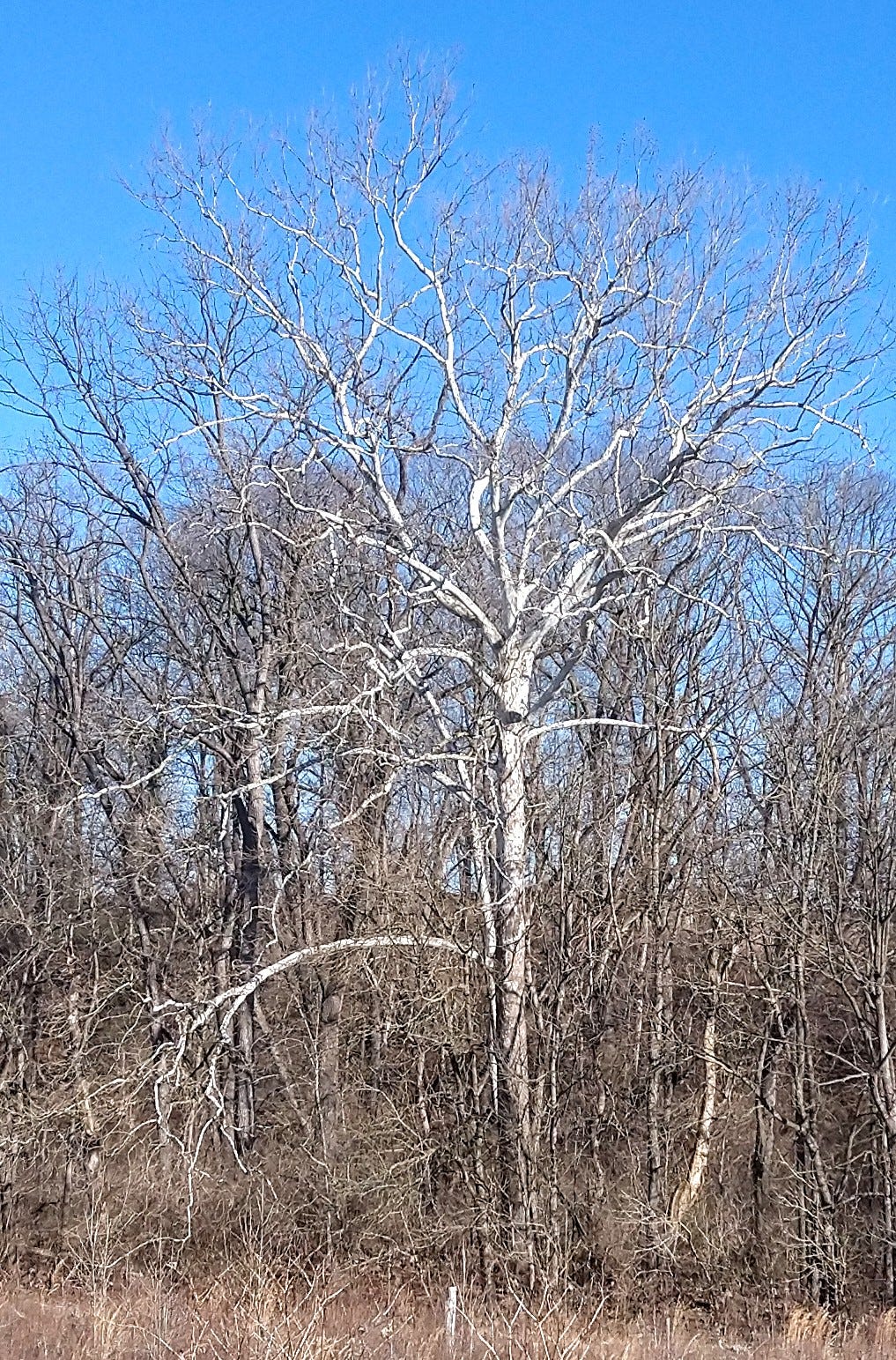
Casually sipping my steaming black morning ritual, I relaxed in my recliner. This comfortable post affords me a cherished view, through the sliding glass doors to our patio, of the wildlife preserve that is our backyard. Predawn peace is the quintessential ruminative occasion for getting my head on straight for a new day.
Shalom shalom. Perfect peace… I will let my mind rest steadfastly upon Jesus my King, as I trust Him… [Deep breathing] What time will I need to leave for my cardiologist appointment? How much time do I have before I have to get in the shower? Plenty of time. Good… Peace, be still...
Then, the sun crested the horizon.
Constantly morphing hues of dawn caught my eyes with a vision unlike any I had the good fortune of noticing before. Artistic resplendence filled the otherwise austere scene of our backyard in the winter months. A lone American Sycamore tree with its characteristic whites and browns now glowed with an iridescence beyond description. I nearly leapt from my chair!
Scrambling for my glasses, and for my phone to capture a picture, I could tell that the incomparable orange glow radiating from the tree would soon be waning. Stepping into the twenty-six degree Fahrenheit morning air, clad only in my slippers, bed-shorts and t-shirt, I snapped a few hasty pictures of the tree line as the sky gave birth to cloudless azure. It was too late. The typical sycamore white was already bleeding through the yellowing orange reflection of the rising sun. The serendipitous vision faded with each exhaled misty fog. Capturing the inspiration to share with my sleeping wife was already a chasing after the wind.
As I sit at my writing desk today, I look out at this tree line. The white sycamore stands out among the plethora of browns. It shines. But there was something holy about the glow that morning. The tree showed forth the glory and excellence of God in that moment. It virtually shouted to me of God’s virtues, His goodness, love and exemplary faithfulness. I think of God’s call upon us, His people, and wonder how we go about being glory proclaimers like the sycamore was that morning.
The Apostle Peter shared a God-truth in his first epistle.
You are coming to Christ, who is the living cornerstone of God’s temple. He was rejected by people, but he was chosen by God for great honor. And you are living stones that God is building into his spiritual temple. What’s more, you are his holy priests. Through the mediation of Jesus Christ, you offer spiritual sacrifices that please God. As the Scriptures say,
“I am placing a cornerstone in Jerusalem,
chosen for great honor,
and anyone who trusts in him
will never be disgraced.”
Yes, you who trust him recognize the honor God has given him. But for those who reject him,
“The stone that the builders rejected
has now become the cornerstone.”
And,
“He is the stone that makes people stumble,
the rock that makes them fall.”
They stumble because they do not obey God’s word, and so they meet the fate that was planned for them. But you are not like that, for you are a chosen people. You are royal priests, a holy nation, God’s very own possession. As a result, you can show others the goodness of God, for he called you out of the darkness into his wonderful light.
1 Peter 2:4-9 NLT
Remember who you are because of whose you are. Remember your chosen-ness. Remember that you are holy because He who called you is holy. Remember that your calling is to be a mediator of King Jesus’ own love for all people. Remember.
The last sentence of the quote is a wonderful description of what happened with the sycamore that morning. “As a result, you can show others the goodness of God, for he called you out of the darkness into his wonderful light” (1 Pt. 2:9). The “you can show” word is ἐξαγγέλλω (ex-ang-el’-lo), and is made up of the preposition ἐκ (meaning out of, from, by), and the word ἄγγελος (ang’-el-os) (meaning messenger), the word from which we get angel. Thus, ἐξαγγέλλω means
to tell out or forth
to declare abroad, divulge, publish
to make known by praising or proclaiming, to celebrate.
It has connections to the word for good news, the Gospel, which in Greek is εὐαγγέλιον (yoo-ang-ghel’-ee-on). You may notice the connection for yourself just by looking at the Greek words, especially the αγγέλ part.
This word carries both the idea of telling, proclaiming, AND showing. As you’ve read, the NLT uses the showing idea, as does the KJV (“ye should shew forth”). The ESV and NIV render the word as “you may proclaim” and “you may declare” respectively. The truth is, by the power of God’s indwelling presence in us by the Holy Spirit we can both proclaim and show the goodness, the excellencies, the praises of God. Indeed we are commissioned to. “And whatever you do or say, do it as a representative of the Lord Jesus, giving thanks through him to God the Father” (Col. 3:17 NLT).
As I experienced the radiance of the tree that particular dawn, I felt in my soul the beauty of the sunrise as it raised the tree from darkness into light, literally from night into day. The vision stirred me. It excited me for the day at hand, with crisp air and crystal skies. I too have been called out of darkness into the life of His wonderful—“The Word gave life to everything that was created, and his life brought light to everyone” (Jn. 1:4 NLT)—light. I am fully alive!
What Peter says we are reflecting/declaring, then, is the “goodness” of God. Some translations say the “praises” or “excellencies” of God. The word in the Greek is ἀρετή (ar-et’-ay), the word commonly used by ancient philosophers like Plato and Aristotle to talk about “virtue.” In Peter’s second letter he writes about how we are called to God’s own self through his glory and ἀρετή, virtue (see 2 Pt. 1:3). Consequently we are instructed to supplement our faith with ἀρετή (2 Pt. 1:5).
This cannot be me trying harder to add a measure of moral uprightness to my trust in the One in whom my life is grounded. That would be like telling the sycamore tree to work harder at glowing and expecting it to do so. No, this supplement is about letting the glory and virtue of God have its effect on me, conforming me to Christ’s likeness. It does not work in reverse, me determining what I feel is morally excellent and attributing that to the Son. The sycamore reflects—adding nothing to—the sun. Lesson learned!
Truly I have wrestled with, contemplated, and prayed for clarity on how I’m supposed to supplement my faith with a “generous provision of moral excellence,” and not get weighed down by my own moral ineptitude—”I don’t really understand myself, for I want to do what is right, but I don’t do it. Instead, I do what I hate” (Rom. 7:15 NLT)—or my own latent Pharisaism—”I thank you, God, that I am not like other people—cheaters, sinners, adulterers. I’m certainly not like that tax collector!“ (Luke 18:11b NLT). It’s all grace, letting Jesus do for me and in me that which I cannot do for and in myself.
God speaks! And God’s word is powerful. The creation… well, “let the trees of the forest sing for joy before the Lord, for he is coming!” (Ps. 96:12b-13a NLT). I will never listen to that sycamore the same way again. It shows and declares the excellencies of God. It is a marker for me of God’s faithfulness. For that I am eternally grateful.
Peace